Car Dent Repair in Sonora, CA: Which Repair Method Does Your Dent Need?
Not every car dent should be repaired the same way. A shallow door ding with intact paint may be a good candidate for paintless dent repair, while a sharp crease, stretched metal, cracked paint, or collision-related dent may require traditional bodywork and refinishing. Severe damage can sometimes make panel replacement the better solution.
For drivers searching for car dent repair in Sonora, CA, the key is determining what kind of damage you actually have before choosing a repair method.
At Phase II Autobody, we handle everything from smaller body damage to collision repairs, painting, refinishing, and more involved restoration work. Instead of assuming every dent needs the same treatment, a proper inspection allows the repair approach to match the actual condition of the vehicle.
What Type of Dent Is on Your Vehicle?
"Dent" is a broad term.
A small round depression in a door and a deeply creased quarter panel are both technically dents, but repairing them can require very different methods.
Some of the most common types of auto body dents include:
- Door dings
- Round dents
- Creased dents
- Body-line dents
- Bumper damage
- Hail-related dents
- Collision dents
- Dents with scratched or cracked paint
- Large areas of distorted sheet metal
The location matters too.
A dent in the middle of an accessible panel can sometimes be easier to work with than damage near an edge, reinforcement, body line, or difficult-to-access area.
Before deciding how a dent should be repaired, technicians need to consider its size, depth, shape, location, paint condition, and accessibility.
Option 1: Paintless Dent Repair for Minor Damage
Paintless dent repair, commonly called PDR, is designed to reshape certain dents without conventional body filler and repainting.
When the damage is suitable for PDR, specialized tools and techniques are used to carefully manipulate the affected area toward its original shape while preserving the existing finish.
PDR can be an excellent choice for certain:
- Door dings
- Shallow dents
- Minor parking-lot damage
- Small impact dents
- Hail-type dents
The major advantage is right in the name: the repair can potentially be completed without repainting the affected panel.
That means the vehicle retains its existing finish in that area.
But PDR is not automatically the right choice simply because a dent looks small.
When Is a Dent a Good Candidate for PDR?
Several factors influence whether paintless dent repair is appropriate.
One of the most important is the condition of the paint.
If the finish remains intact and flexible enough, PDR may be possible. If the impact has cracked, chipped, or significantly scraped the paint, correcting the shape alone won't address all of the damage.
The shape of the dent also matters.
A broad, shallow dent may respond differently than a sharp crease where the metal has been heavily stressed. Location can also affect tool access and repairability.
A professional assessment looks at all of these variables together rather than deciding based solely on diameter.
Option 2: Traditional Dent and Body Repair
When PDR isn't appropriate, traditional auto body repair may be the better approach.
This method can address dents where:
- Paint has been damaged
- Metal requires more extensive reshaping
- The dent is sharply creased
- Collision damage involves surrounding areas
- Additional surface correction is necessary
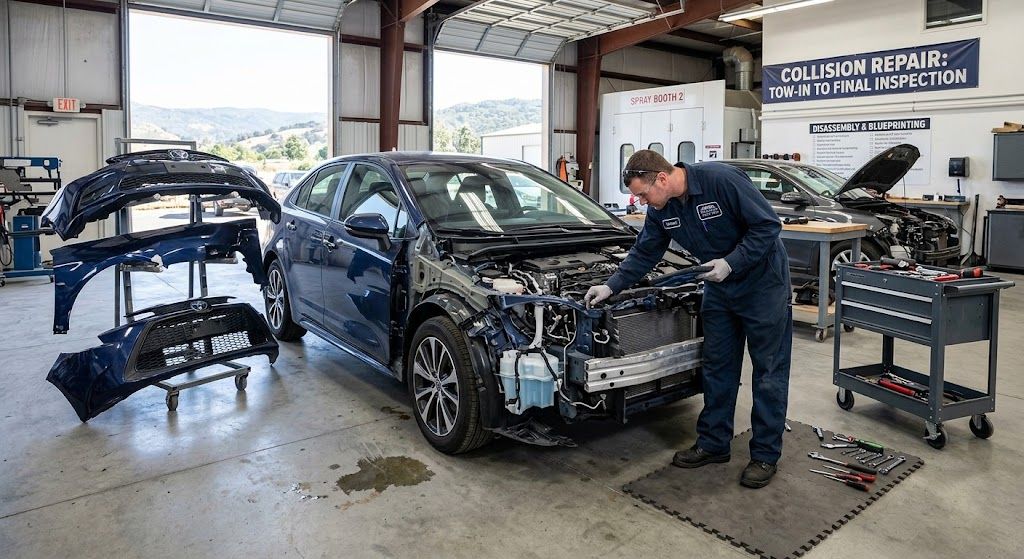
Depending on the repair, technicians may reshape the damaged area and perform the preparation necessary to create a smooth surface before refinishing.
The goal isn't simply to fill a low spot and cover it with paint. Good body repair requires attention to the panel's contours and the surrounding surface so the repaired area integrates properly with the rest of the vehicle.
Traditional bodywork takes more steps than PDR because the finish generally needs to be restored afterward.
Option 3: Dent Repair With Paint Refinishing
Sometimes the metal can be repaired but the paint cannot.
Imagine another vehicle's door hits yours hard enough to create a dent and remove paint from the impact area. Even if the dent itself can be corrected, the damaged finish still needs attention.
Paint refinishing can involve several stages, depending on the repair:
- Surface cleaning
- Sanding and preparation
- Primer when needed
- Color matching
- Basecoat application
- Blending when appropriate
- Clear coat
- Finishing and inspection
Matching automotive paint is more complex than choosing a color that appears close.
A vehicle has paint identification information that provides a starting point, but the existing finish may also be affected by age, environmental exposure, previous refinishing, and other factors.
The refinishing process is therefore an important part of achieving a cohesive final repair.
Option 4: Panel Replacement for Severe Damage
Not every damaged panel should be repaired.
If a panel has extensive distortion, severe collision damage, or other problems that make repair impractical, replacement may be considered.
Whether replacement is appropriate depends on the specific component and type of damage.
For example, a severely damaged bolt-on component can present a different repair decision than damage to a panel that is integrated into the vehicle's body structure.
This is another reason an estimate should be based on an inspection rather than photographs alone.
The least invasive method isn't automatically the best method, and replacement isn't automatically necessary just because a dent looks dramatic.
The objective is to select an appropriate repair based on the actual damage.
Can a Dent Cause More Than Cosmetic Damage?
Yes.
A simple parking-lot ding may be primarily cosmetic, but dents caused by collisions can be associated with additional damage.
A visible dent could be accompanied by damage to:
- Mounting points
- Adjacent panels
- Bumper components
- Lamps
- Trim
- Components located behind the panel
- Structural areas in more significant impacts
That's particularly important when a dent resulted from a crash rather than a small isolated impact.
If your vehicle was struck hard enough to create significant body damage, evaluating the surrounding area can be just as important as correcting the visible dent.
Should You Repair a Dent If the Car Still Drives Fine?
Whether a cosmetic dent bothers you is ultimately your decision, but there are several reasons owners choose to repair body damage even when the vehicle remains drivable.
Appearance
Dents can be particularly noticeable on clean, reflective body panels. Repairing them restores a more consistent exterior appearance.
Paint protection
If the impact damaged the finish and exposed underlying material, addressing the area can help prevent the damaged finish from deteriorating further.
Resale or trade-in presentation
Visible body damage can affect how prospective buyers perceive the condition of a vehicle.
Identifying underlying damage
When the dent came from a meaningful collision, an inspection can help determine whether anything besides the exterior panel was affected.
Not every ding needs urgent repair, but damage involving broken paint or a substantial impact deserves more attention than a purely cosmetic imperfection.
What About Dents on Body Lines?
Body lines are the sculpted creases and contours manufacturers build into vehicle panels.
Damage along one of these lines can be more complicated than a similar-sized dent on a relatively flat portion of the panel.
Why?
Because the repair needs to recreate not only the general panel shape but also the defined contour that gives that area its original appearance.
This is a good example of why dent size alone doesn't determine repair difficulty.
A smaller dent in a complicated location can require more skill and time than a larger, shallow dent in an accessible area.
What About Aluminum Body Panels?
Not every vehicle panel is made from the same material.
Modern vehicles may use steel, aluminum, plastics, composites, and other materials in different areas. These materials do not necessarily respond to repair techniques in exactly the same way.
Knowing what you're working with is therefore an important part of determining the repair process.
This is particularly relevant when owners try to judge a repair based on a dent that looks similar to damage they previously had on another vehicle. Two visually similar dents can require different procedures because the vehicle, panel construction, access, and material are different.
Should You Try DIY Dent Repair?
DIY dent-removal videos make some repairs look deceptively simple.
Suction devices, glue-pulling kits, heat, and improvised tools are widely available, but using the wrong method can potentially make professional repair more complicated.
Possible problems include:
- Creating high spots
- Damaging otherwise intact paint
- Increasing the size of the affected area
- Distorting the panel
- Damaging trim or components while trying to access the dent
For an older vehicle with little value, an owner may decide that experimentation is acceptable. For a vehicle where finish quality matters, getting an assessment first can prevent a small problem from becoming a larger one.
How Much Does Car Dent Repair Cost?
There isn't one useful price that applies to every dent.
The cost depends on factors including:
- Dent size
- Depth
- Location
- Number of dents
- Panel material
- Accessibility
- Paint condition
- Whether refinishing is necessary
- Whether adjacent areas are damaged
- Whether parts must be removed
- Whether the panel can be repaired at all
A tiny accessible dent suitable for PDR is a very different job from a creased collision dent requiring bodywork and refinishing.
That's why a repair estimate based on the actual vehicle is more meaningful than a generic online price range.
How Long Does Dent Repair Take?
The same principle applies to repair time.
A straightforward PDR job may require much less time than traditional body repair involving preparation and refinishing. More extensive collision-related damage can take longer still, particularly if replacement parts are needed.
Ask the shop what repair method it recommends first. Once the scope is understood, you'll have a much better basis for discussing the expected schedule.
Choosing Dent Repair in Sonora, CA
When comparing auto body shops, don't focus only on who offers the fastest or cheapest dent repair.
Instead, ask how the shop determined the repair method.
A useful explanation should tell you whether:
- PDR is possible
- The finish has been compromised
- Conventional bodywork is necessary
- The panel needs refinishing
- Replacement is being considered
- Other collision damage is present
The recommendation should make sense for your particular vehicle.
Phase II Autobody serves Sonora and surrounding communities and handles a range of repairs, allowing the repair approach to be based on the damage rather than forcing every dent into one method.
Frequently Asked Questions About Car Dent Repair
Can every car dent be repaired without paint?
No. Paintless dent repair works for certain types of damage, particularly when the existing finish remains intact and the dent can be properly accessed and reshaped. Other dents require conventional body repair and refinishing.
Can you fix a dent if the paint is scratched?
Potentially, yes, but fixing the dent won't automatically repair the finish. If the paint has been significantly damaged, refinishing may be part of the repair.
Is a small dent always inexpensive to repair?
Not necessarily. Location, access, panel material, body lines, paint condition, and other factors can make a relatively small dent more complicated than its size suggests.
Is it better to repair or replace a dented panel?
That depends on the extent and type of damage. Many panels can be repaired, while severely damaged components may be better candidates for replacement. An inspection is the best way to determine the appropriate approach.
Can dents from an accident hide additional damage?
Yes. When a dent resulted from a collision, damage may extend to components or areas behind the visible exterior surface. More significant impacts should be professionally evaluated.
Get Car Dent Repair in Sonora, CA
The right way to fix a dent depends on more than how large it looks.
A shallow ding may be an excellent candidate for paintless dent repair. A dent with damaged paint may require bodywork and refinishing. More severe collision damage could require a different repair approach entirely.
Phase II Autobody provides auto body repair, paintless dent repair, collision repair, and auto paint and refinishing services for drivers in Sonora and surrounding communities. Our team brings more than 120 years of combined experience to evaluating and repairing vehicle damage.
If you have a dent and aren't sure what type of repair it needs, start with an inspection rather than guessing.
Call Phase II Autobody at (209) 536-4924 to discuss your vehicle and arrange an estimate.
Phase II Autobody
14987 Camage Avenue
Sonora, CA 95370
Monday–Friday: 8:00 a.m.–4:30 p.m.
From everyday door dings to more substantial collision-related dents, Phase II Autobody can help determine the appropriate path toward restoring your vehicle's body and finish.